
What happens when you design a supertall residential tower around wellness principles rather than treating them as an afterthought?
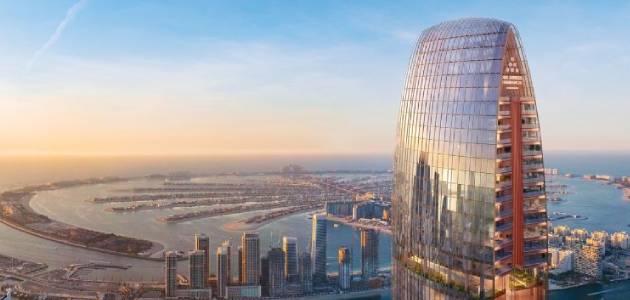
At the Property Technology Confex, Laura Dianu, Head of Design at Select Group, presented the thinking behind Six Senses Residences Dubai Marina, positioned as the world’s tallest residential tower at 518 metres and 122 storeys. The project combines biophilic design, sustainability engineering, and intelligent building systems to establish a new benchmark for what high-rise residential living can deliver.
The height is notable. The method is more so.
Adaptive Reuse at Scale: Building on What Already Exists
The project did not begin with a blank site. The original Pentominium Tower stood unfinished, a structure that had reached 29 floors before stalling. Rather than demolish and rebuild from the ground up, the design and delivery team made a deliberate decision to retain the existing foundations and completed floors, then redesign everything above.
This was not a compromise. It was a strategic choice with measurable outcomes, including significant reductions in embodied carbon and a meaningful increase in usable floor area. Adaptive reuse at this scale is still uncommon in high-rise residential development. Six Senses Dubai Marina makes the case that it is not only viable but advantageous.
Structural Engineering as a Design Enabler
Building a 518-metre residential tower on an inherited structure requires more than ambition. It requires precise structural innovation.
Dianu outlined the lateral stability system developed in collaboration with WSP, which incorporates core walls, composite mega columns, and double-storey steel outrigger trusses. Structural optimisation reduced unnecessary shear wall mass, which in turn improved the tower’s silhouette, maximised view corridors, and increased overall efficiency.
The result came after 18 design iterations. This was not a process of guesswork. It was a process of modelling, measurement, and refinement, repeated until the structural solution performed to the required standard across every dimension.
Sustainability Engineered Into the Structure
The sustainability outcomes at Six Senses Dubai Marina are a direct consequence of structural and design decisions, not a layer applied after the fact.
Retaining the existing structure delivered a 40 percent reduction in embodied carbon compared to a full demolition and rebuild. Structural optimisation produced an 8 percent increase in sellable carpet area. These are not marginal gains.
The broader sustainability framework spans four pillars: climate, resources, society, and technology. Specific strategies include structural weight reduction, wind engineering simulations, and durability measures designed to extend asset life across the long term. The project is targeting LEED Silver certification, with identified contingency routes toward Gold. Dianu was clear that certification is not the primary objective. The objective is a building system that performs better for residents and for the city over time.
Supporting systems include:
- Automated HVAC calibrated by CO2 sensing
- Energy modelling that informed envelope performance decisions
- Smart lighting controls
- Native planting that reduces outdoor water consumption by 50 percent
- Use of condensation water for irrigation
Wellness as a Vertical Experience
The most distinctive aspect of the project is the treatment of wellness not as an amenity category but as an organising principle for the entire tower.
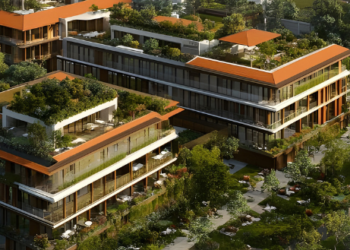
Dianu described a deliberate wellness narrative that runs vertically through the building, from the podium level to the upper floors. At the 109th floor, the Horizon Level functions as a biophilic retreat in the sky, designed for psychological calm as much as visual impact. Sky gardens and integrated planting appear across multiple levels. Sensory design, sound environments, wellness clinics, wet treatments, gym facilities, and Earth Lab spaces are distributed through the tower with intention.
Material and architectural choices are shaped around emotional journey, from grounded tactility at lower levels to what Dianu described as calm in the clouds at the upper floors. The podium level supports community-oriented wellbeing experiences designed to embed routine into daily life.
This is not a collection of premium features. It is a curated lifestyle sequence, designed floor by floor with a consistent wellness logic running through it.
A Replicable Framework, Not a One-Off Flagship
Dianu closed the presentation with a claim that carries implications beyond this single project: Six Senses Residences Dubai Marina is intended as proof of concept for a broader approach.
Adaptive reuse can function at significant heights. Luxury and low-carbon design are not in conflict. Vertical wellness is a viable response to cities that are becoming denser, hotter, and more constrained in terms of available land.
As urban development pressure increases across the GCC and globally, the methodology demonstrated here — reuse the existing, optimise the structure, measure the outcomes, and design wellness into the system from day one — has the potential to serve as a template rather than an exception.
Watch the full presentation for the complete discussion.